Neutral Tones
Thomas Hardy's 'Neutral Tones' is a devastatingly bleak exploration of the end of a relationship, where the natural world reflects the death of love. It is highly rewarding to study because its intricate circular structure and pessimistic imagery provide rich material for AO2 language and form analysis.
Study Notes
Overview
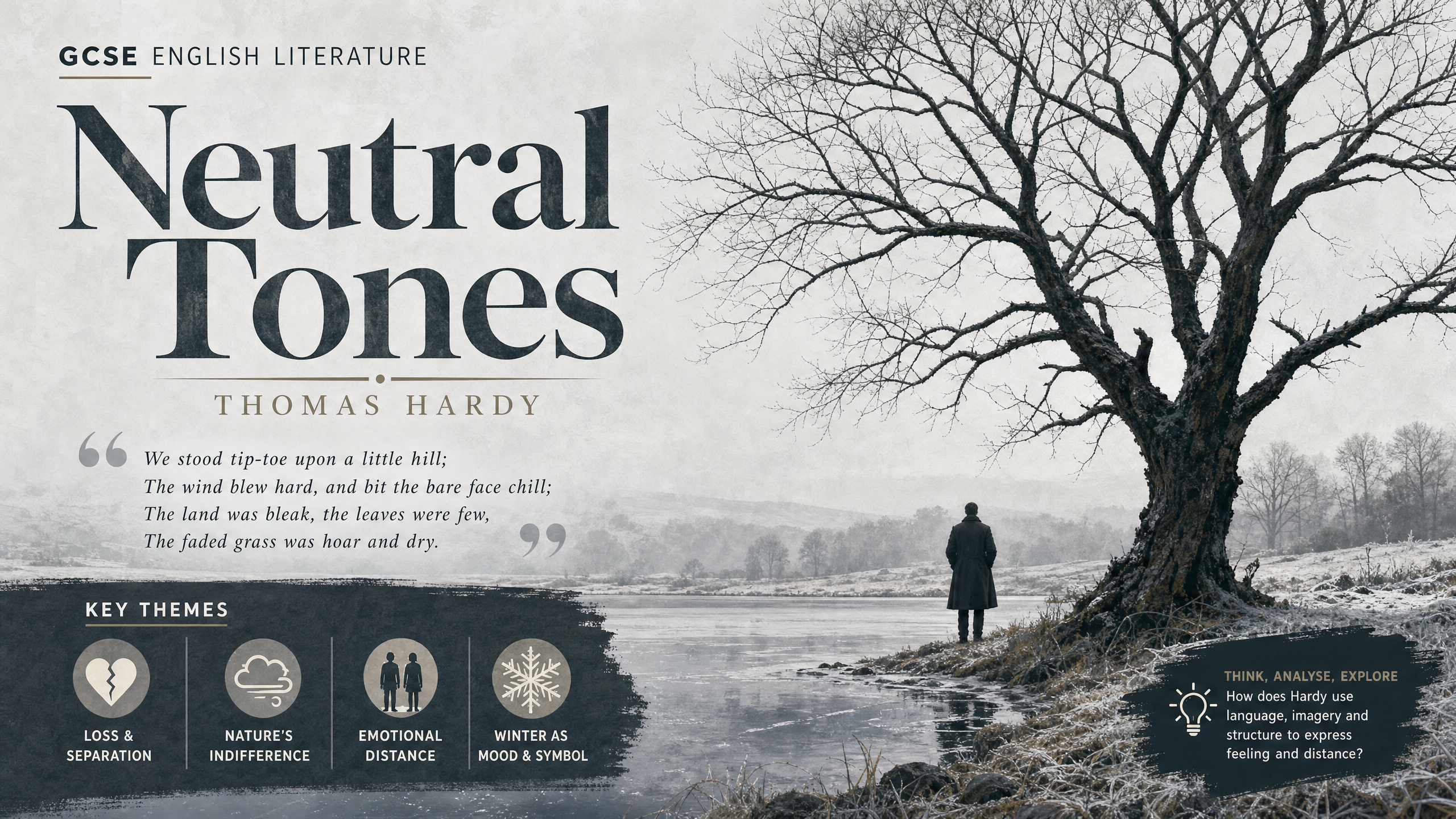
Thomas Hardy's 'Neutral Tones' (written in 1867) is a quintessential example of Victorian pessimism, exploring the bitter end of a romantic relationship through a memory recalled years later. The poem uses stark, colourless imagery and a bleak winter setting to mirror emotional emptiness. Examiners consistently reward candidates who can confidently explore the poem's dual timeline (the past memory versus the present reflection) and who can analyse how the title's ambiguity—referring to both the visual landscape and the emotional numbness of the speaker—operates throughout the text.
Content Overview
The poem is a single, retrospective memory consisting of four stanzas:
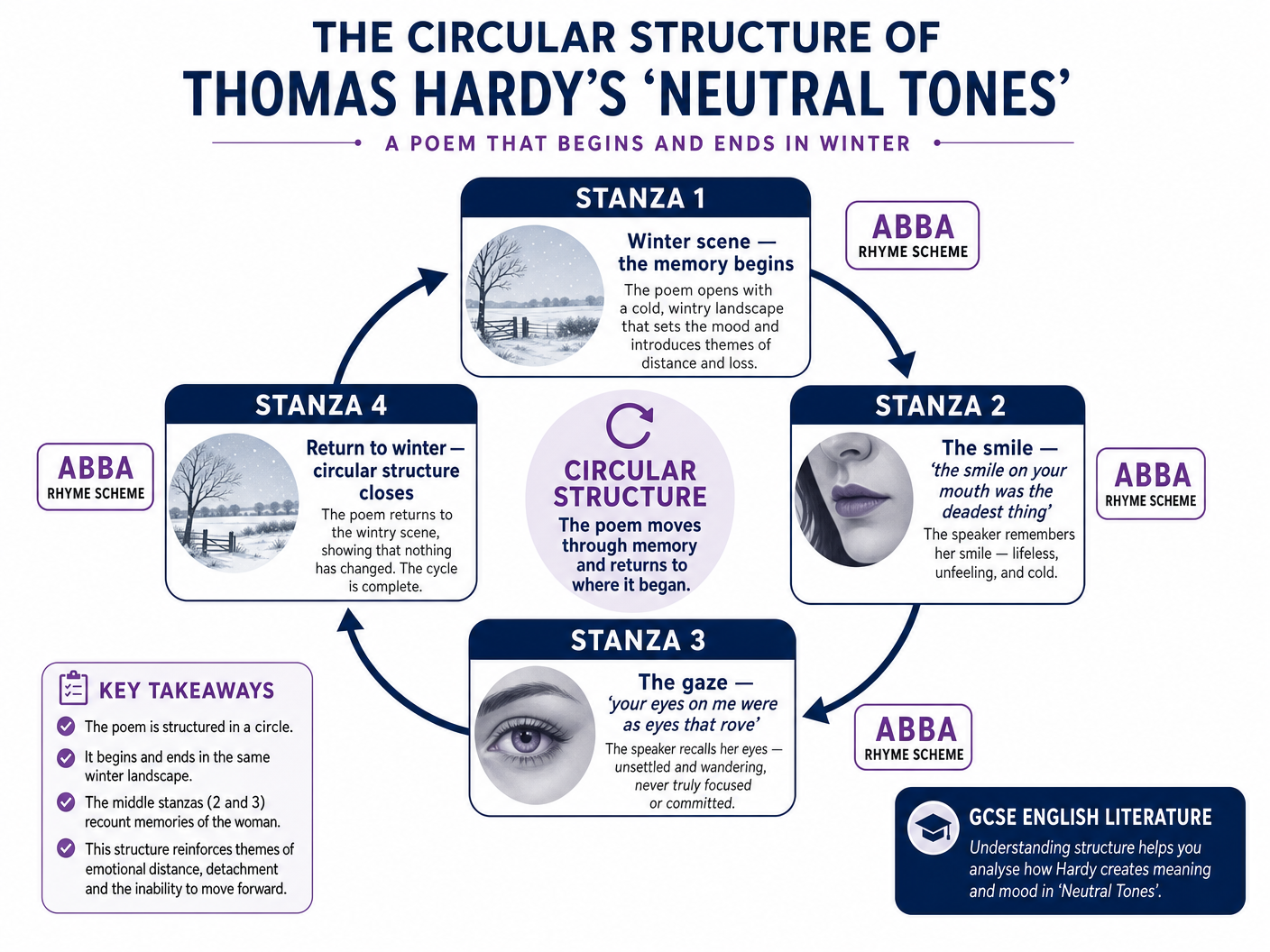
- Stanza 1: The speaker sets the scene by a winter pond, describing a white sun and grey leaves, establishing the pathetic fallacy.
- Stanza 2: The focus shifts to the woman's face, specifically her smile, which is paradoxically described as 'the deadest thing'.
- Stanza 3: The speaker recalls her gaze, which wanders aimlessly over 'tedious riddles', highlighting the emotional distance between them.
- Stanza 4: The poem returns to the present, revealing that this single memory has permanently shaped the speaker's cynical view of love, closing with the same winter imagery.
Themes
Theme 1: Loss and Emotional Death
Hardy presents the end of the relationship not as a fiery, passionate argument, but as a slow, cold withering. The landscape is drained of life, reflecting the emotional state of the lovers.
Key Quotes:
- "the smile on your mouth was the deadest thing" (Stanza 2) - The oxymoron captures the paradox of a relationship that technically exists but has lost all vitality. The superlative 'deadest' emphasises the absolute absence of feeling.
- "alive enough to have strength to die" (Stanza 2) - This paradox highlights the painful, lingering nature of the breakup.
Theme 2: Nature and Pathetic Fallacy
The natural world in 'Neutral Tones' is hostile and indifferent. Hardy uses pathetic fallacy, but instead of nature sympathising with the speaker, it seems to actively reflect the death of the relationship.
Key Quotes:
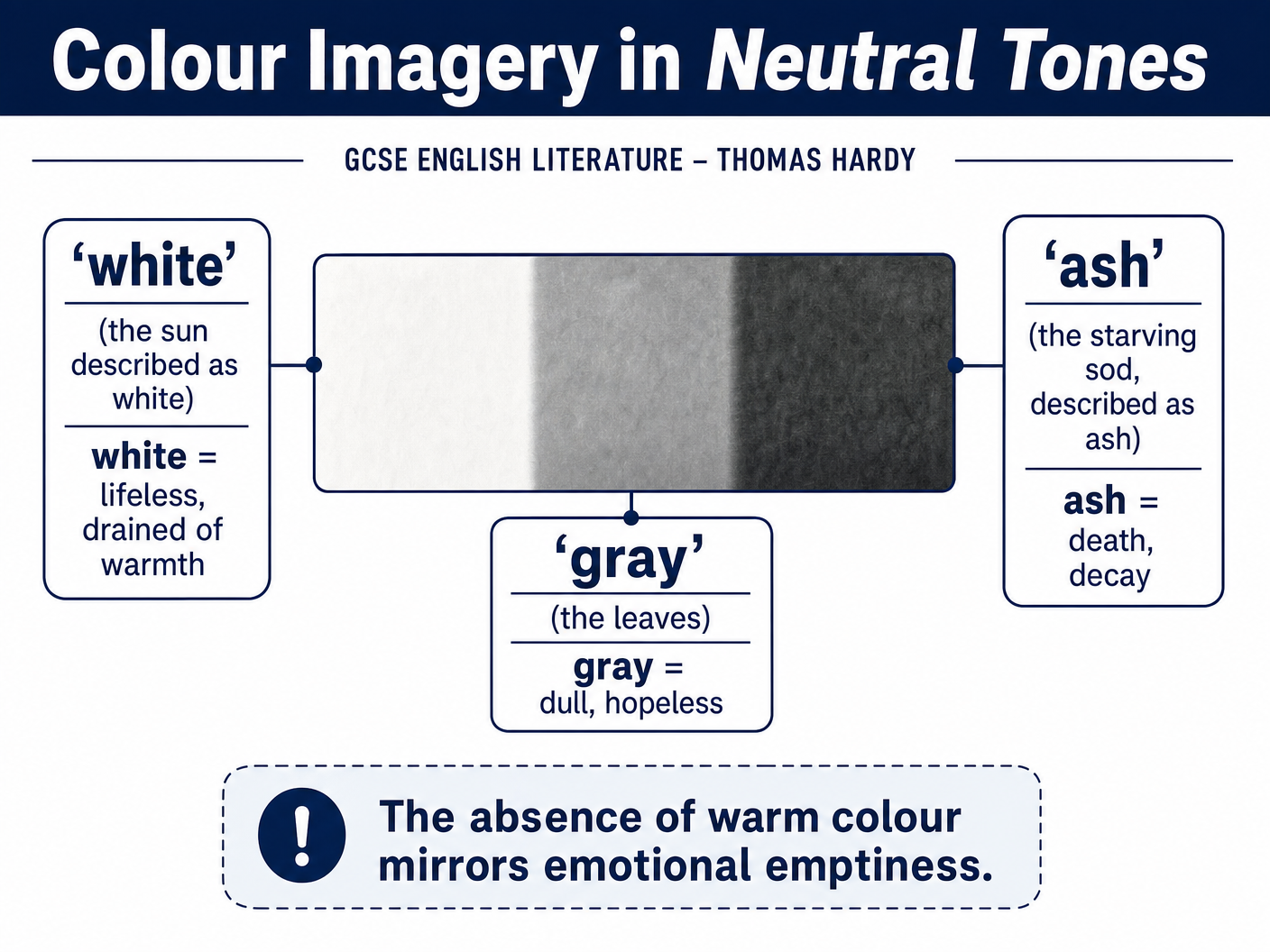
- "The sun was white, as though chidden of God" (Stanza 1) - The sun, usually a symbol of warmth and life, is drained of colour and seemingly rebuked ('chidden') by God, reflecting Hardy's pessimistic view of a universe indifferent to human suffering.
- "And a few leaves lay on the starving sod; / - They had fallen from an ash, and were gray." (Stanza 1) - The use of 'starving' personifies the earth as deprived of nourishment, mirroring the emotional starvation of the lovers. The colour 'gray' and the tree name 'ash' evoke death and decay.
Theme 3: Memory and the Passage of Time
The poem is deeply concerned with how past trauma shapes present reality. The final stanza reveals that the memory of this day has coloured all the speaker's subsequent experiences of love.
Key Quotes:
- "Since then, keen lessons that love deceives" (Stanza 4) - The adjective 'keen' suggests sharp, painful learning. The memory is not just a passive recollection; it is an active, ongoing lesson in disillusionment.
- "And wrings with wrong, have shaped to me / Your face, and the God-curst sun, and a tree, / And a pond edged with grayish leaves." (Stanza 4) - The polysyndeton (repetition of 'and') creates a sense of overwhelming, inescapable memory. The poem ends exactly where it began, demonstrating the speaker's inability to move on.
Writer's Methods
Form and Structure
- Circular Structure: The poem begins and ends by the winter pond. This structural circularity mirrors the speaker's emotional state—trapped in the memory and unable to move forward.
- Rhyme Scheme: The regular ABBA rhyme scheme creates an enclosed, trapped feeling. The first and last lines of each stanza rhyme, trapping the middle two lines, just as the speaker is trapped by the memory.
- Rhythm: The rhythm is often irregular and halting, reflecting the awkwardness and discomfort of the memory.
Language and Imagery
- Colour Imagery: The poem is dominated by a semantic field of colourlessness—'white', 'gray', 'ash'. This visual neutrality mirrors the emotional neutrality of the relationship.
- Oxymoron and Paradox: Phrases like 'the deadest thing alive' force the reader to confront the unnatural state of the dying relationship.
Context
Thomas Hardy (1840-1928) was a Victorian writer known for his philosophical pessimism. Unlike the Romantic poets who saw nature as a source of spiritual renewal, Hardy often depicted nature as indifferent or even hostile to humanity. This reflects the broader crisis of faith in the late 19th century, influenced by Darwin's theories of evolution, which challenged the idea of a benevolent Creator. Examiners reward candidates who can link the 'God-curst sun' to Hardy's pessimistic worldview.
Audio Resource
Listen to the comprehensive 10-minute podcast covering core concepts, exam tips, and a quick-fire recall quiz:
Visual Resources
2 diagrams and illustrations
Interactive Diagrams
1 interactive diagram to visualise key concepts
Conceptual Flow Outline
The Circular Narrative Structure of Neutral Tones
Worked Examples
2 detailed examples with solutions and examiner commentary
Practice Questions
Test your understanding — click to reveal model answers
Compare how poets present the loss of love in 'Neutral Tones' and in one other poem from your anthology.
Hint: Consider the different ways loss is experienced. Is it a sudden shock, or a slow decay? How do both poets use natural imagery to reflect this?
How does Hardy use the setting to create a sense of hopelessness in 'Neutral Tones'?
Hint: Focus on the specific adjectives used to describe the sun, the leaves, and the earth. How do these words strip the landscape of life?
Explore the significance of the poem's title, 'Neutral Tones'.
Hint: Think about the double meaning of 'neutral'—both the visual lack of colour (white, grey) and the emotional lack of feeling (numbness, indifference).
How does the structure of 'Neutral Tones' contribute to its meaning?
Hint: Focus on the circular structure, the ABBA rhyme scheme, and the shift in time in the final stanza.